Angel Investors: An Interview with Dr. Helga Kronheim
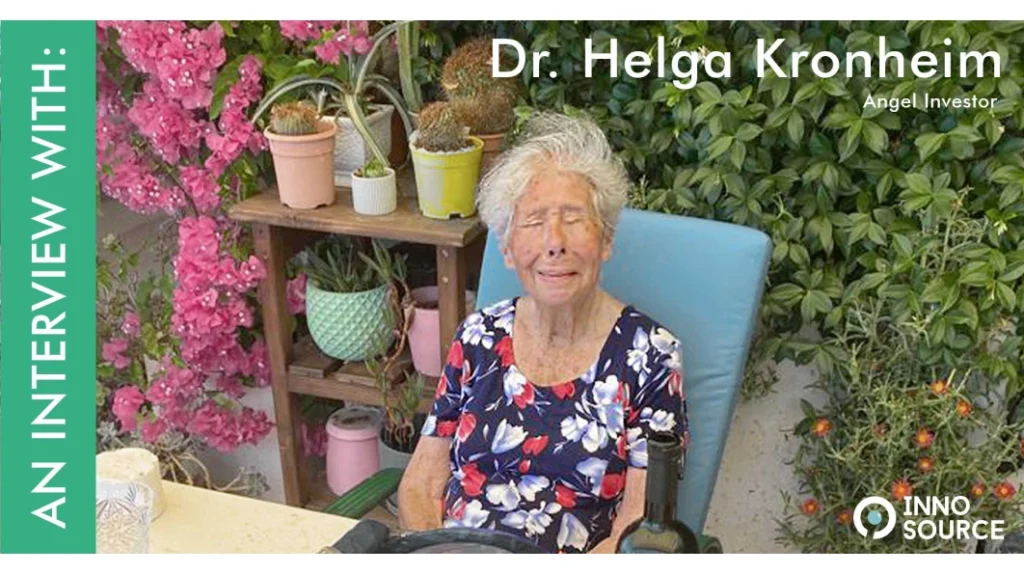
Dr. Helga Kronheim is a 93-year-old angel investor based in Israel. She was born in Germany but escaped to Israel in 1939 before the Holocaust. Later she left for Switzerland to pursue her doctoral studies in mathematics and physics at the University of Zürich. Despite her interest in theoretical physics, she ended up becoming an actuary because of her overwhelming interest in people. For 38 years and most of her career, she lived in Amsterdam though her work as Reinsurance Executive included international travel for about half of her working life. After retirement, Dr. Kronheim returned to Israel, and loves being back home.
What made you decide to become an angel investor?
Towards the end of my job in Holland, I happened to meet an Insurance Executive who was planning a startup to replace antibiotics. I was very impressed and was sure that this venture would prove to be important for humanity. Micreos, being the only company I ever invested in abroad, is already improving lives of many thousands of people and is well on its way to become a unicorn! As my adventure with Micreos started, so did my interest to venture further into the world of startups. I enjoyed meeting young people and listening to their dreams and plans. With money obviously being limited, I had a difficult time choosing in which of the companies to invest in, with many of them sounding most impressive. About half of “my startups” went bust, others are lingering on, and a few are on their way to great success. All in all, I am sure that the end results will be good.
How did you decide which startups to invest in?
It largely depended on my impression of the founder, whether the product would be useful for humanity and an estimate of its market potential. For example, one of the companies I am invested, RedDress, is an Israeli startup that aims to treat chronic wounds that are considered unhealable. I also looked out for companies with convincing technology.
Investing into startups has turned out to be a kind of an occupational therapy for me because I got interested in a lot of different subjects and widened my horizon. Though I must say that I have no interest in crypto, even though it might well be the future [laughing].
What did you learn about angel investing over all these years?
If I could start over again, I would probably evaluate startups differently. Having said this, I’m not so sure if that would have made me a more successful investor. They say that up to 90% of startups fail, I am already doing better than that.
Have there been any recent innovations which have sparked your interest?
I had a visitor sharing with me that maybe, just maybe, they are on the way to finding a medication for Alzheimer’s disease. If I were still investing, I would follow this up.
Although this may deviate from the topic of this interview, I recommend to anybody suffering from memory problems to regularly eat a fair amount of blueberries. I found this out by chance before reading up on it.
Which do you think is the most interesting startup you invested in?
I would say Micreos and RedDress, both of which I have already mentioned, as well as Antidote Health, an Israeli telehealth company offering digital medicine to underprivileged people in the United States. The latest investor of Antidote is one of the world’s top basketball players, who is convinced that everybody, regardless of color and/or income, is entitled to affordable medical treatment.
Is there anything that these three startups have in common that excite you?
All three of them have found solutions that can help people improve their lives.
What is the best advice you would give to young people perusing angel investing?
I have two pieces of advice which I think could be important for many. The first one is to be positive. See the glass as half full. The second is to not to worry. Worrying is a waste of energy. Look for solutions instead.
To younger people specifically, I would advise you to choose a profession that will interest you not only now but also in the future. I think that having an interesting, fulfilling job is as important as having a partner. After all, we spend so many of our waking hours with our work.
Is it more important to you to have an interesting career than to move up the corporate ladder?
Yes. During an interview after joining the management of the reinsurance company I worked at, I was asked whether I had always been ambitious. My negative response was that I had always wanted to have the most interesting work I could get. My career in reinsurance career allowed me to see the world, meet the most special people and experience things I would have never been exposed to otherwise. For example, I had the chance to have lunch with Carlos Slim some 30 years ago, who was at that time (before Facebook and the like) the richest person in the world and really a most unusually interesting person.
I am also not impressed by titles! I am impressed by people, their character, their integrity and their abilities. What they achieved from what they had set out to achieve. I remember working with a very young broker in Mexico whose boss only wanted to talk to the wealthy and preferably people in high positions. I strongly believe that people shouldn’t be evaluated in such a way.
Is there any advice you would give to women specifically?
I have two pieces of advice. First, deliver the best work you while knowing your own value. Stand up for yourself. Do not let anybody put you down and do not accept a salary lower than that of your male equivalent. I succeeded over 60 years ago when I was offered a salary of 30% less, so you should succeed now. Second, I encourage women to rethink the #MeToo movement. It could do a lot of damage to women in the job market. Enjoy the tension and attraction between the sexes also at your job, it’s one of the things that makes life worth living.