Innovation Insights with CEOs: MITJA SCHULZ

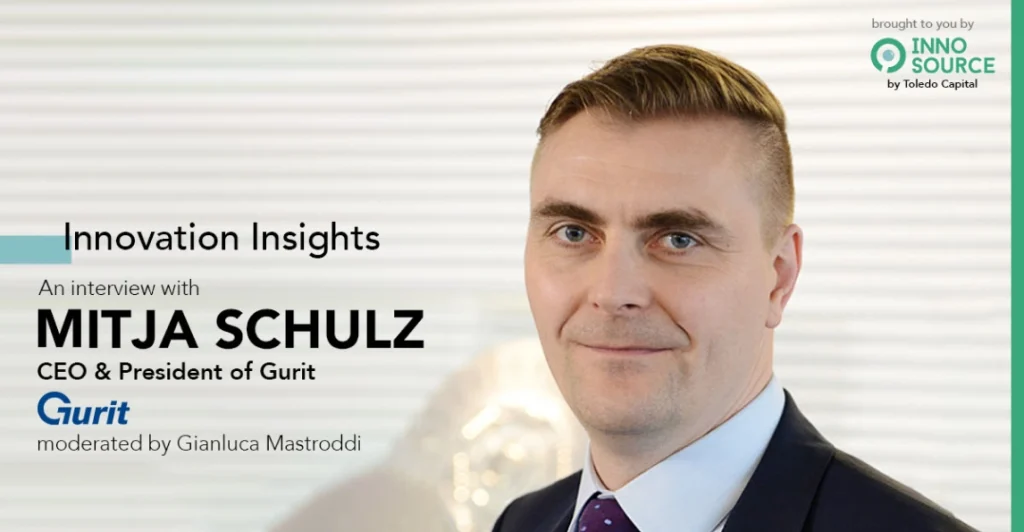
Mitja Schulz is the president and CEO of the leading global supplier of advanced composite materials company, Gurit. With almost 20 years of experience in the automotive industry, he shares his thoughts on the necessity of innovation for corporations in today’s competitive global business environment.
Do you think innovation is key to success?
Yes, I think innovation is key to success. But I also think that it depends on the position of your company in the global competitive landscape. In most of the industries I have worked in, such as automotive, many of the major competitors are Chinese companies. China’s strong domestic market and government funding towards startups enables many of these Chinese firms to have better cost positions for available technology. To remain competitive, we thus need to keep up with the latest technology. In this sense, being an innovative company is essential to us.
How is innovation perceived and fostered in your company?
At Gurit, we are currently in the process of changing our approach towards innovation. Thus far, focus has very much been on product innovation. For example, when producing performance materials like carbon fibers, we were always looking to make the next product lighter or cheaper. Yet for me, it’s more about creating an innovative culture rather than an innovative product. It starts by embedding the desire to be an innovation leader in the company’s long-term strategy, vision and mission statement. Nonetheless, it’s not easy to quantify what makes you an innovative company. In the past, patents were key innovation indicators. Today, we use a mix of diverse ‘quantified KPIs’ instead.
Another important aspect of innovation is employee engagement and empowerment. It’s about all employees contributing to innovation development. Ideally you want employees to question the business processes and then strive to come up with ways to make them more efficient. For example, systematically embedding innovation initiatives directly into target agreements and management systems. Above all however is allowing employees to have the necessary freedom to think outside the box. A flexible working environment, meetings for creativity and offering agile development processes are possible ways to provide employees with additional innovation resources. You can’t become an innovative company overnight simply because you hired the five smartest engineers in the world.
How do you see corporate venturing as an innovation driver?
It’s certainly an important element. When thinking about product innovation, the first step is to consider ‘trend scouting’ by identifying new technology or other disrupting events that could potentially impact your business. For instance, in the wind power industry for instance, it’s currently the strong digitalization of wind turbine components. Technology such as smart rotor blades is impacting Gurit as a supplier of rotor blades. Thus, we need to consider how we can translate these trends into our own technology roadmap. On one hand, we collaborate with universities and research institutes to better understand how product solutions could look like from our own company perspective. On the other hand, we work together with other organizations, often startups. For instance, Israel’s advanced startup ecosystem is often utilized to outsource camera, radio and autonomous driving technology within the automotive industry.
What are some of the main challenges of corporate venturing?
While working in the automotive industry where venture capital engagement was frequent, the biggest challenge was the stark difference between how the companies operated. Bigger enterprises often have more structured yet slower processes whereas smaller firms have much leaner structures and faster processes. While collaborating, the practices of the corporation slows down the startup and may even incentivize some of the startup’s most valued employees to leave as they would no longer have full control over the decision process.
On the positive side, it’s a great opportunity to improve your time to market. Working together with a startup that fundamentally operates much faster means that a product solution can be developed much quicker. It also offers you a different perspective on how to approach your problem.
What are the key factors in identifying the right strategic partners?
The first is whether there is a technology fit. Having lived in the US for three years, I had the opportunity to visit the Silicon Valley on multiple occasions and participated in uncounted amounts of pitches from startups promising you the world. It’s extremely important to understand the value and qualities of performance the startup can offer.
The second is the joint understanding of the management. Are we all working towards the same purpose? This is often underestimated, but in business collaborations, it’s a very important aspect to consider. I’ve seen cases where there was a technological fit but once collaboration started, there was a huge disconnection between the management practices and values of the startup company and the larger organization.
The last is a common understanding on potential synergies and the long-term goal of the collaboration. It’s crucial to define what incremental customer value will be generated through the collaboration at the beginning.
Is there any advice you would give to aspiring startup founders?
First and foremost, I think that you need to be convinced that you can generate a certain USP that differentiates you from the rest. Next, you should not only be motivated by the potential income multiplier you generate when selling your company as this is a rather short-term perspective. Last but not least, take initiative and make things happen rather than wait for others to tell you what to do.